Many Ottawa families start considering Orleans when their current home no longer fits their way of life.
A smaller condo, townhome, or older urban property can feel limiting once children, work-from-home needs, storage, parking, and outdoor space become part of daily life.
For families considering moving east, Orleans offers more space, established neighbourhoods, and family-focused housing options within Ottawa.
This guide explains why families are moving to Orleans, what to consider before choosing the area, and how to plan the move without being caught off guard by space, access, or timing issues.
Quick Answer
Families choose Orléans for spacious homes, yards, and garages that support practical family routines. Transitioning from compact urban properties into these larger suburban layouts simply alters your moving logistics. It means managing more furniture, basement storage, and outdoor equipment, requiring different vehicle capacities and loading strategies than a smaller city move.
The Main Relocation Patterns We See Across Ottawa
Families relocating towards Orleans often come from different parts of the city.
The reasons behind this relocation trend vary, but a few common themes recur.
Let’s explore them in greater detail:
1. Outgrowing The Downtown Core
Families moving from Centretown, Sandy Hill, the Glebe, or nearby downtown areas are often leaving behind tighter layouts, street parking, elevator bookings, or walk-up access.
The move to Orleans usually means more space, but it also means a different moving setup.
A family going from a condo or apartment into a detached or semi-detached home may suddenly have more rooms, a garage, a basement, and outdoor areas to organize.
Moving crews need to know both sides of the move: the tight pickup access downtown and the larger unloading layout in Orleans.
2. Leaving Smaller West-End Homes for More Space
Westboro, Hintonburg, Wellington Village, and nearby areas remain desirable, but many families reach a point where their home size no longer meets their needs.
Some households look east because Orleans family homes may offer more usable space, finished basements, attached garages, home offices, and larger family layouts.
From a moving perspective, these moves often include a mix of standard furniture, fragile pieces, basement items, bikes, seasonal storage, and outdoor equipment.
That inventory needs to be reviewed carefully before confirming truck size.
3. Moving Between Ottawa Suburbs
Some families move from Kanata, Barrhaven, Findlay Creek, or other suburbs into Orleans because of school preferences, family networks, work routines, or community connections.
These types of moves can look simple because they stay within Ottawa, but the travel time still matters.
Cross-town timing, Highway 174 traffic, driveway access, and unload placement all affect the schedule.
A suburb-to-suburb move can still require a detailed inventory review, especially when the family is moving from one full household into another larger home.
What Should Families Check Before Moving Into An Orleans Neighbourhood?
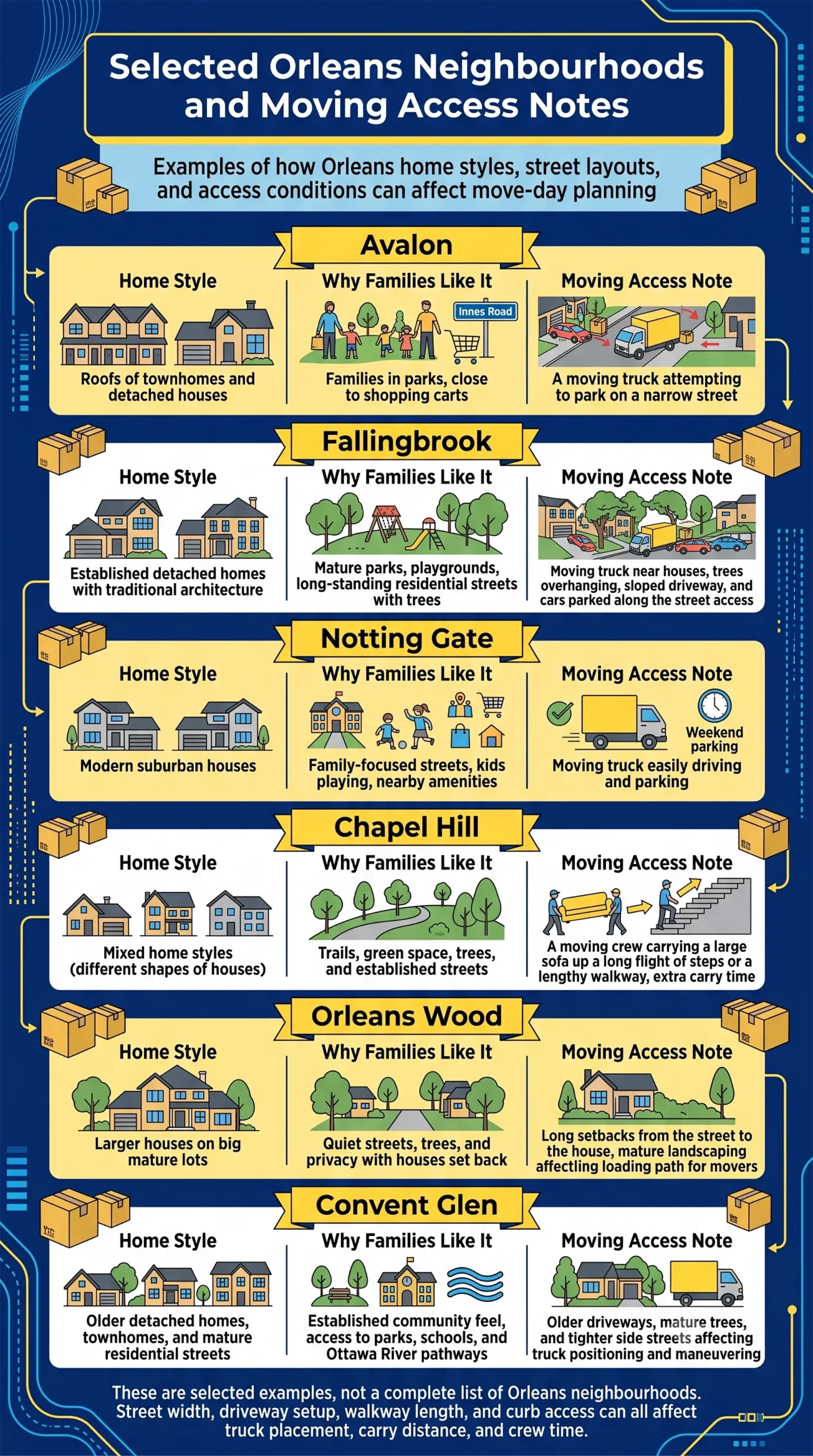
The same access check applies beyond the neighbourhoods listed above. Other Orleans areas, including Queenswood Heights, Chateauneuf, Chatelaine Village, Springridge, Cardinal Creek, Bradley Estates, Gardenway, Hiawatha Park, Petrie’s Landing, and Trailsedge, can also have different street widths, driveway setups, home ages, and access conditions.
Economical Movers Tip for Families Moving to Orleans: Before booking movers in Orleans, check street width, driveway access, truck parking, walkway length, front steps, tree clearance, and weekend street parking. These details may not stop the move, but they can affect truck placement, carry distance, crew time, and the written estimate.
What Changes When Families Move Into Orleans Homes
Living in Orléans, Ontario, can feel very different from living in a downtown condo, a compact townhome, or an older home with limited space.
The biggest adjustment is often not the distance of the move but the layout of the new property.
Many families gain additional functional areas, such as a finished basement, garage, home office, playroom, or dedicated storage space.
This shift affects moving day in several ways. Larger homes typically require a more organized unloading plan, with boxes and furniture distributed across multiple levels and rooms rather than a single main living area.
For that reason, it helps to label boxes according to where they belong in the new home, for example, “Basement Rec Room,” “Home Office,” or “Garage Storage”, rather than simply using labels from the previous property.
Doing so allows movers to place items in their intended locations and can make unpacking significantly more efficient.
The Highway 174 Timing Factor
For many families, a cross-town relocation to Orleans involves transporting household belongings from central or western neighbourhoods to the east end of Ottawa.
The route may look simple on a map, but timing can matter more than distance.
A delay on the way to Orleans can affect elevator bookings at the pickup, key pickup timing, school-day schedules, unload time, and how late the crew can safely finish.
This matters most when the move starts from a condo, apartment, downtown street, or west-end neighbourhood where loading time is already controlled by parking, elevators, or building rules.
Before booking the move, confirm three timing details:
- when the crew can start loading
- when keys or possession timing is confirmed
- whether the move has a fixed deadline, such as elevator time, school pickup, or evening building rules
For local Ottawa moves, the distance may not look large, but the timing plan can still change how the whole day is scheduled.
Strategic Moving Note: If your Orleans move involves a condo pickup, key-release timing, or school-day pressure, avoid treating the route as “just a short local drive.” The safer plan is to build the schedule around loading windows, possession timing, and realistic travel time, not only the distance between addresses.
The Inventory Shift Families Often Miss
Families moving from smaller homes often estimate the move based on the amount of furniture and boxes. That is where many Orleans moves get underestimated.
A move to a condo or smaller townhome may have a predictable load: bedrooms, living room furniture, kitchen boxes, clothing, and a few stored items.
A family move into Orleans often has a wider inventory footprint. The move may include items from storage areas, outdoor spaces, garage zones, children’s activities, home offices, and seasonal household use.
That is why movers in Orleans should ask about more than the number of bedrooms.
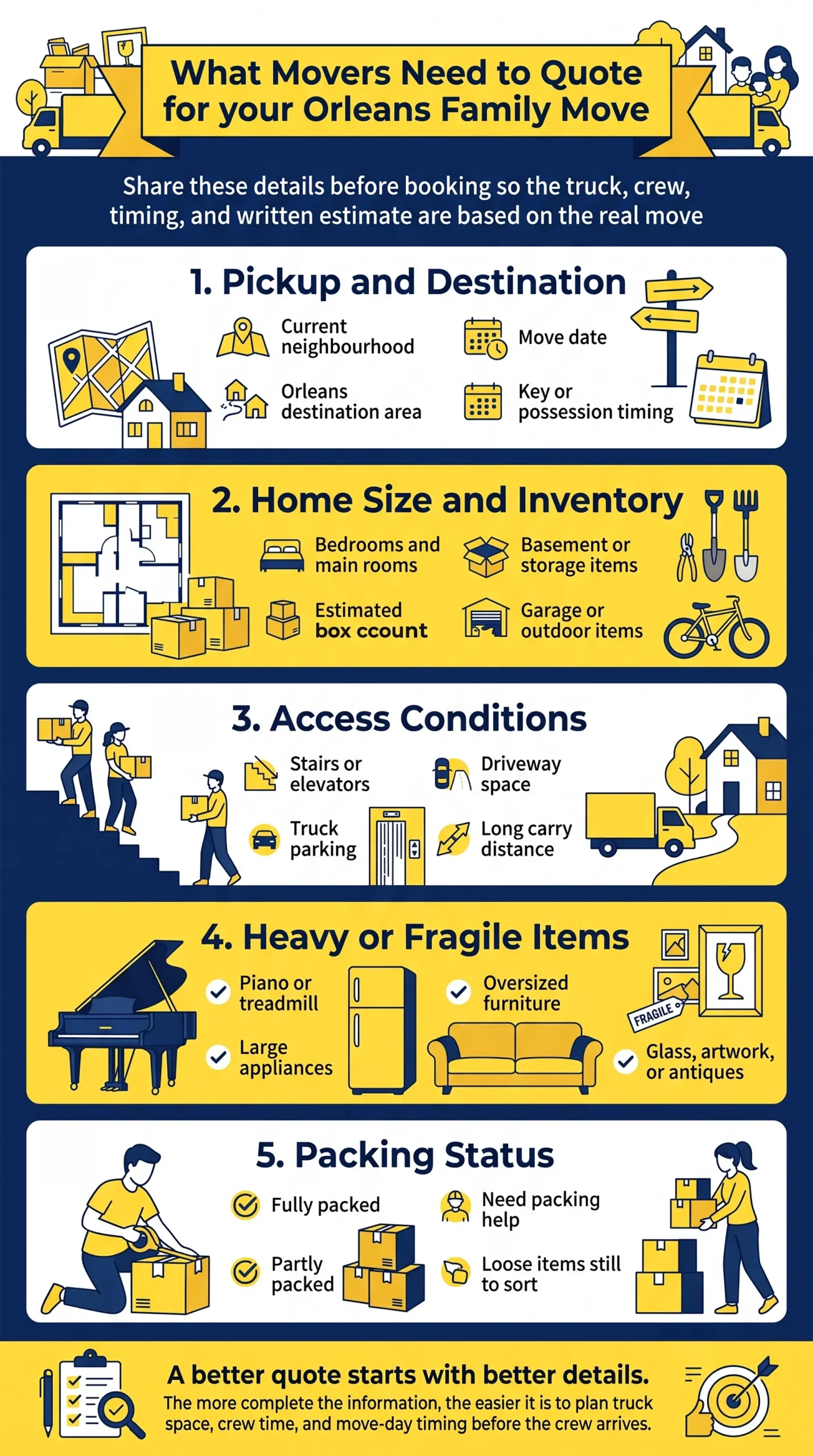
A proper estimate should confirm:
- rooms being moved
- estimated box count
- storage and overflow items
- outdoor or seasonal items
- appliances and large furniture
- heavy, fragile, or high-value pieces
- stairs, elevators, driveway, and parking conditions
The goal is not to make the move sound complicated. The goal is to price and plan the real shipment, not a smaller version of the home.
Cost of Living in Orleans: What Families Should Check Before Deciding
The cost of living in Orleans may feel more manageable for families comparing it with smaller or higher-priced homes in central or west-end Ottawa.
The appeal is often usable space: more bedrooms, a garage, a basement, and outdoor room for family life.
Still, families should look beyond the purchase price or rent. A larger home can also change monthly costs, seasonal upkeep, and the moving budget.
Things to check include:
- property tax or rent
- utilities for a larger home
- commuting costs
- insurance
- school or childcare needs
- snow removal or lawn care
- home maintenance
- moving, storage, disposal, or junk removal costs
For moving costs, many local Ottawa family moves are priced hourly in CAD.
As a general range, local Ottawa moving rates often fall between $130 and $250+ per hour, depending on crew size, truck, minimum hours, travel time, access conditions, and the moving date.
A larger Orleans family move may cost more if it includes a full basement, garage inventory, outdoor items, heavy pieces, stairs, long carry distance, packing help, or extra disposal needs.
Important note: School registration, childcare availability, commute times, household expenses, municipal details, and moving rates can change. Families should confirm current information with the relevant school board, childcare provider, municipality, landlord, realtor, service provider, or moving company before making decisions.
How Economical Movers Helps Plan an Orleans Move
Economical Movers reviews Orleans moves based on the full home setup, not only the bedroom count.
For families moving from a condo, townhome, or smaller Ottawa home into a larger Orleans property, this review can help confirm truck space, crew time, access needs, and unloading placement before moving day.
Moving Into Orleans? Let’s Plan It Properly
Whether your family is moving into Avalon, Fallingbrook, Chapel Hill, Orleans Wood, Convent Glen, or another Orleans neighbourhood, share your pickup address, Orleans destination area, moving date, inventory size, packing status, and any access concerns.
We can use those details to prepare a written quote that reflects your actual move conditions.