Warehouse moving in Ottawa often starts with a signed lease and a moving date that already feels too close. You’ve got racking full of stock, a forklift or two, suppliers still sending deliveries and customers who expect their orders this week. None of that stops because you’re changing buildings. Getting the order of jobs right is what keeps the move from turning into a week of missed shipments.
Below, you’ll find what to check in the new building, how to handle your racking, how to keep orders going out during the move, what retail stock and forklifts need, what the old landlord expects and what to have ready before you ask for a quote.
What Makes Warehouse Moving In Ottawa Different?
Most of the city’s warehouse space sits in a few industrial pockets:
- East: Sheffield, Hawthorne and Conroy
- South: Hunt Club and the Bank Street area near Leitrim
- West: Kanata, Bells Corners, Stittsville and Carp
- Across The River: Gatineau
Crossing town on the 417 several times a day adds up fast.
Spring is the season that catches people out. During the thaw, usually early March to mid-May, the City limits heavy vehicles to 5 tonnes per axle on roads marked as restricted, sometimes with only a few days’ notice. A trailer loaded with racking steel or a forklift can go over that. Check both addresses on the City’s truck route and seasonal load map (Check Source Below) before you pick dates.
Winter is doable, just slower. Snow in the yard, ice on dock plates, and overnight parking bans all get in the way, so book snow clearing at both sites for every moving morning and build in extra time.
Heading to Gatineau? Quebec has its own trade licensing and building permits, so your racking installer and electrician need to be qualified to work there.
What Should You Check In The New Warehouse Before You Move?
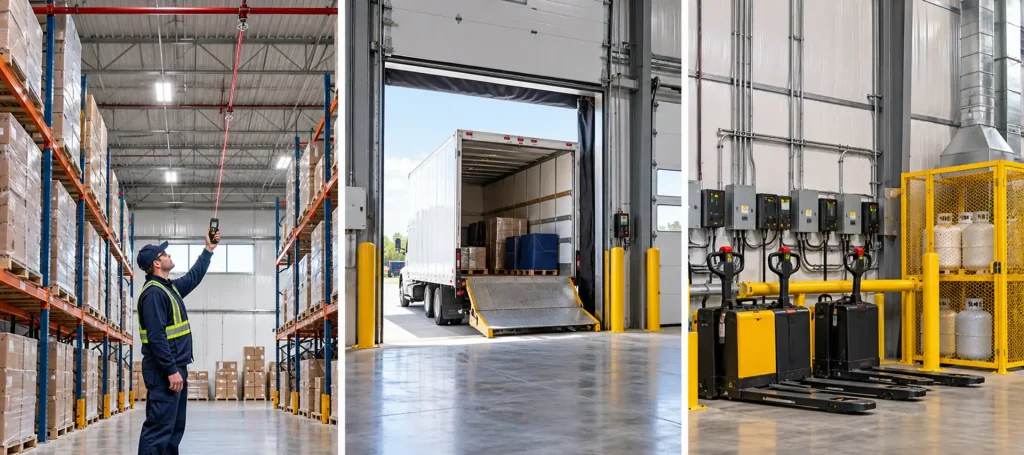
People rush this step and regret it later. Do it before you sign the lease if you can.
Clear Height and Sprinkler Limits
The height on a listing sheet is often taken at the roof’s highest point. What matters is the clear height where your racking will stand, under the lowest beam, duct or light. Measure it and compare it with your tallest racking.
Then look up at the sprinklers. Ontario’s Fire Code(Check Source Below) requires at least 457 mm (18 inches) between the sprinkler heads and the top of any storage, so your top pallet will sit lower than the ceiling suggests. Lose one beam level across a whole building, and you can be hundreds of pallet positions short. Check with the building owner or a fire inspector what storage height the system was designed for.
Floor, Dock Doors and Truck Access
Walk the floor where your uprights will go. Racking is bolted into the concrete, and cracks, saw-cut joints, and patched spots are poor places for anchors. If the slab looks doubtful, have an engineer confirm it can take the load.
Next, the doors. Dock-height doors let trailers load level with the floor, while grade-level doors suit straight trucks and driving forklifts in and out. Count them at both sites, because the number of trucks you can load at once sets the pace of the whole move. Check that the dock levellers work, too.
Finally, stand in the yard and picture a 53-foot trailer backing in. Is there room to swing around?
Power, Chargers and Propane
Forklift chargers usually need dedicated circuits, often three-phase. Have an electrician check the new site early, or your forklifts will arrive with nowhere to charge.
Running propane forklifts? Cylinders are normally kept in a locked, ventilated cage outside, and propane in Ontario falls under TSSA rules. Ask the landlord where the cage can go.
Lithium forklift batteries need a safe charging spot set up to the manufacturer’s instructions.
Should You Move Your Racking, Sell It or Buy New?
Review the table to make an efficieent plan
| Option | When It Makes Sense | What To Watch For |
|---|---|---|
| Move Your Existing Racking | It’s in good shape, has its paperwork, and fits the new clear height | Labour to take it down and rebuild it, plus new anchors |
| Sell It And Buy Used | The new layout needs different frame heights or beam lengths | Parts from different brands usually don’t fit together |
| Buy New | There’s no documentation, lots of damage or a much taller building | Lead times for steel and engineering costs |
Whatever you pick, check for damage first. Bent uprights, dented beams and cracked baseplates won’t improve on a truck. Tag them and leave them behind.
Keep the load signs and capacity documents with the racking. Without them, proving it’s safe at the new site gets much harder.
Who puts it back up? Many movers can rebuild standard pallet racking, while racking installers also handle layout drawings, anchoring and engineering paperwork. Often the mover hauls it and an installer rebuilds and signs off.
The paperwork is what delays most moves. In Ontario, installing racking can require an engineer’s pre-start health and safety review(Check Source Below), and new pallet racking generally needs a building permit too. Ask the City of Ottawa’s Building Code Services and your building owner what applies before you book installation dates.
How Do You Keep Orders Shipping During A Warehouse Move?
The short answer: don’t move everything at once.
Before The Move: Count Stock And Set A Receiving Cut-Off
Do a full stock count before anything leaves. Without that baseline, you’ll never know whether something went missing in the move or was already short.
Pick a receiving cut-off date, the day after which every delivery goes to the new building. Freight already booked to your old address is the usual mess, because carriers go wherever the paperwork says.
Then give suppliers and carriers your new dock address and receiving hours two to three weeks ahead, and confirm a week before.
A Phased Moving Plan That Keeps You Running
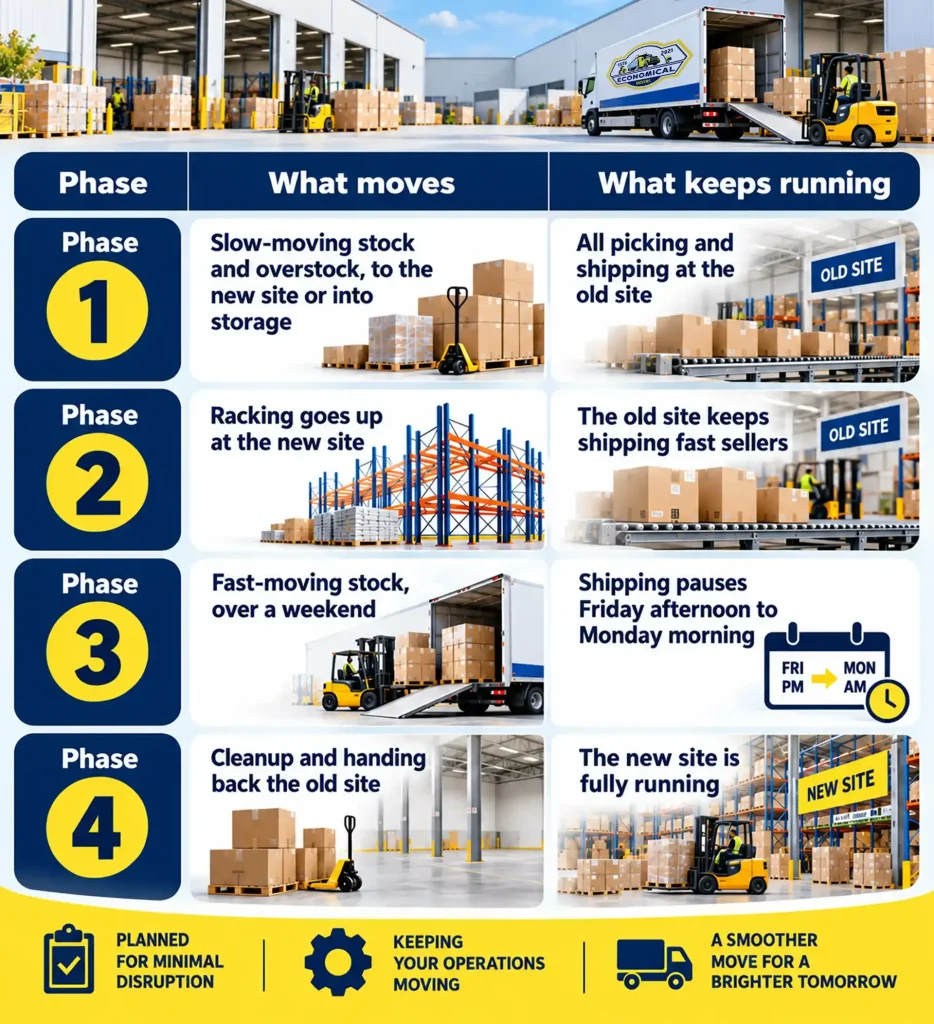
Slow stock goes first because nobody needs it this week. Moving it early, or into short-term storage, also frees up old racking to come down and go up at the new site. For the overstock itself, here are the options for slow-moving inventory.
After The Move: Recount And Update Bin Locations
Recount within the first week and compare it with your first count. Any gap points to stock that was lost, damaged, or put away in the wrong spot.
And update bin locations before anyone picks an order. If the system still shows old locations, your pickers will spend the first morning wandering the aisles.
How Do You Move Retail Stock Without Losing Sales?
If you run a stockroom or small warehouse behind a shop, a retail store relocation has an extra layer.
Move the stockroom first. Back stock can go days ahead while the store keeps selling from the sales floor right up to the last day.
Online orders are where things usually go sideways. Pause in-store pickup and ship-from-store a day before stock leaves, and update your online stock levels. Otherwise, someone buys a jacket that’s sealed in a box on a truck.
Decide on old or damaged stock before it’s packed, so you don’t pay to move it.
Once everything’s in, match your before and after counts. That’s how you catch shrink while it’s still easy to trace.
How Are Forklifts and Heavy Equipment Moved?
Forklifts don’t fit in a regular moving truck. They’re heavy and the mast is usually too tall, so they travel on a flatbed or float trailer. Check each forklift’s data plate and pass the exact weight to whoever is arranging transport.
Batteries need care. Lead-acid ones are heavy and full of acid, so they stay upright and strapped down. Propane cylinders shouldn’t ride on the forklift at all.
Give operators time to learn the new layout before the first busy shift. New aisles and rack heights take getting used to.
Conveyors usually need the supplier or a millwright to disconnect and restart them. For bigger machines, there’s more to moving heavy machinery.
What Do You Owe Your Old Landlord Before You Leave?
A racked warehouse leaves marks. Expect to fill or cut flush hundreds of anchor holes, patch the floor, repair any dock damage, and clean up forklift marks. Plan your lease overlap around the phases, with about a week to spare for this work. For the general steps, see these make-good and lease steps.
What Do Movers Need From You For An Accurate Warehouse Quote?
A vague request gets a vague quote, and the difference shows up on the final invoice. Before asking for prices on inventory moving services, have these ready:
- Square footage at both sites
- Pallet count
- Racking bays and beam levels
- Rack heights
- Dock doors at both sites
- Forklifts and heavy machines
- Dates and phases
- Hours when you can’t be down
Then ask every mover the same three questions:
- Have you taken down and put up racking before?
- How will the forklifts be moved?
- What does your coverage pay out for pallets of stock?
That last point matters because standard moving coverage is often based on weight rather than value, which may leave your stock underinsured. For more information about warehouse moving services, see this overview.
Download: Ottawa Warehouse Move Checklist (PDF)
Moving Your Warehouse Soon?
No two warehouse moves look alike once you’re standing in the building. If you’d like someone to talk your plans through with, our team is happy to go over your stock, racking, and timeline with you and put together a free quote for warehouse moving in Ottawa. And if offices or a storefront are part of the move, we handle commercial moving in Ottawa too.
Reference:
City’s truck route and seasonal load map: – (https://ottawa.ca/en/parking-roads-and-travel/traffic-services/truck-routes-and-seasonal-load-restrictions)
Fire Code – (https://www.ontario.ca/laws/regulation/070213)
Pre-start health and safety review – (https://www.ontario.ca/document/guideline-pre-start-health-and-safety-reviews/item-3-racks-and-stacking-structures)