Your furniture was damaged by your movers or a box is missing. What should you do?
First of all, take photos of the issue, provide the moving company with written notification and check the claim period in the contract. Retain the damaged item, packing materials and delivery documents until the company has had an opportunity to investigate.
The evidence you submit is as vital to proving damage as the damage itself when dealing with moving claims in Ontario. Taking a photo of a scratched table is easy, but determining when and how it was scratched is another matter.
This guide covers reporting damage, filing a damage claim, dealing with compensation and challenging a claim when it is refused.
1. What Should Be Your First Step When Movers Damage Your Furniture?
If you see any damage during the moving process, consult the crew leader before they move out.
Inspect large-scale furniture, appliances and the number of boxes received. Do not open all cartons at once, but if there is damage to the carton or something is missing, note this.
Do the following five steps:
- Photograph The Damage: Use close-up photographs and larger photos showing the whole object.
- Inform The Crew Leader: Ask for the problem to be recorded on the delivery paperwork.
- Check Your Inventory: Compare the things sent with the moving inventory, if it existed.
- Keep The Documents: Keep the delivery receipt, inventory and damage notes in writing.
- Do Not Touch Or Move The Item: Try to keep it until the mover has had a reasonable chance to inspect it, unless it is necessary to make repairs or dispose of it to ensure safety.
What If The Movers Refuse To Record The Damage?
Avoid arguing with the crew or signing a statement that you think is incorrect.
Photograph the damage, make a written note of the disagreement and notify the moving company’s office directly. Request a written confirmation.
Always sign delivery documents after reading. If possible, make a note of the damage or disagreement in the document and save a copy.
A Picture Of An Item Can Help Prove That Damage Exists, But It Doesn’t Necessarily Prove When The Damage Occurred. Before-And-After Pictures, Delivery Notes, And An Inventory Can Assist In Determining What Has Happened.
Also, the Government of Canada’s moving advice suggests that people have items checked when they unload and record any damage or missing items.
2. What If You Discover Damage After The Movers Leave?

Not all issues are apparent during the move.
While you are unpacking, you might find a cracked mirror, find a broken chair leg under the wrapping or find a damaged appliance upon set up in your new home.
This is sometimes referred to as “hidden damage”.
Report any issues in writing immediately when they are noticed. Add the date it was moved, the date it was discovered, photographs and a description of the packing or placement location.
If already unpackaged – take some photos of what is left. Keep broken pieces, labels and other evidence.
What If You Don’t Have Before-And-After Photographs?
It’s not too late to report the damage.
Find out what furniture was originally in the home, by looking at early photos. Photographs of the real estate listing or pictures of the family before they move in may help to show the original condition.
Describe the time at which the damage was found and if it was still wrapped at that time. If you didn’t see it, don’t say you do.
A signed delivery receipt does not necessarily mean that all of the items were received in good order and condition. The problem is that the longer you delay reporting hidden damage, the more difficult it’s going to be to determine when it actually occurred.
3. How Long Do You Have To File A Moving Damage Claim In Ontario?
There is not a universal claim deadline for all Ontario moving companies and all moving types.
The federal Office of Consumer Affairs recommends that claims typically should be made within 30 days of a local move and within 60 days of a long-distance move.
These are general consumer guidance dates, not universal legal dates.
The obligations that apply to you are outlined in your moving agreement and under the applicable law.
Note: What Is the Economical Movers’ Claim Deadline?
Submit written loss or damage claims within 60 days, or the minimum period allowed by applicable law. Immediately notify the mover to inspect damaged items and original packing materials. Since the agreement restricts post-submission claims (subject to law), distinguish initial damage notices from final formal claims. Thoroughly inspect deliveries before finalizing claims, never miss deadlines, and promptly report late-discovered damage to confirm your rights.
4. How To File A Written Damage Claim With Movers
A phone call may alert the company, but don’t rely on a verbal conversation as your only record.
For support for customers, the claims contact is typically identified in the supplied agreement.
Include your name, moving date, pickup and delivery addresses, booking or invoice number, and a description of each damaged or missing item.
What Evidence Should You Include?
| Document | Why It Helps |
|---|---|
| Moving Agreement | Shows the agreed terms and liability provisions |
| Delivery Paperwork | Records problems identified during delivery |
| Before-and-After Photographs | Helps establish the item’s condition |
| Moving Inventory | Helps identify and trace missing belongings |
| Purchase Receipts | Supports the item’s original value |
| Repair Estimates | Helps establish possible repair costs |
Sample Moving Damage Claim Email
Subject: Damage Claim – Move on [Date]
Hello,
My move took place on [date] between [pickup address] and [delivery address], and I have discovered damage.
Booking number: [Number]
Description of damaged or missing item:
Problem: [Specific damage or loss]
Date discovered: [Date]
I’ve included photos and the moving documents I have available. Any damaged items and packaging have been retained for examination, where applicable.
Please confirm that your claim has been received and inform me of the next steps required to submit and evaluate my claim.
Thank you.
What If A Box Is Missing?
Before concluding that a box was lost in transit, check the rooms at both properties, any storage areas involved and whether it was placed among other delivered items.
Provide the box’s inventory number, labels or distinctive markings. Describe the contents as accurately as possible.
A numbered box is easier to trace than a report stating that kitchen items are missing.
What About Damage To Walls Or Floors?
Photograph the damage and its location. If you’re in an apartment or condo, keep any building management incident report and repair estimate.
Report property damage separately from damage to transported belongings, since different terms or liability considerations may apply.
5. How Much Compensation Can You Receive For Damaged Furniture?
One of the biggest misunderstandings about moving claims is assuming compensation automatically equals the item’s purchase price.
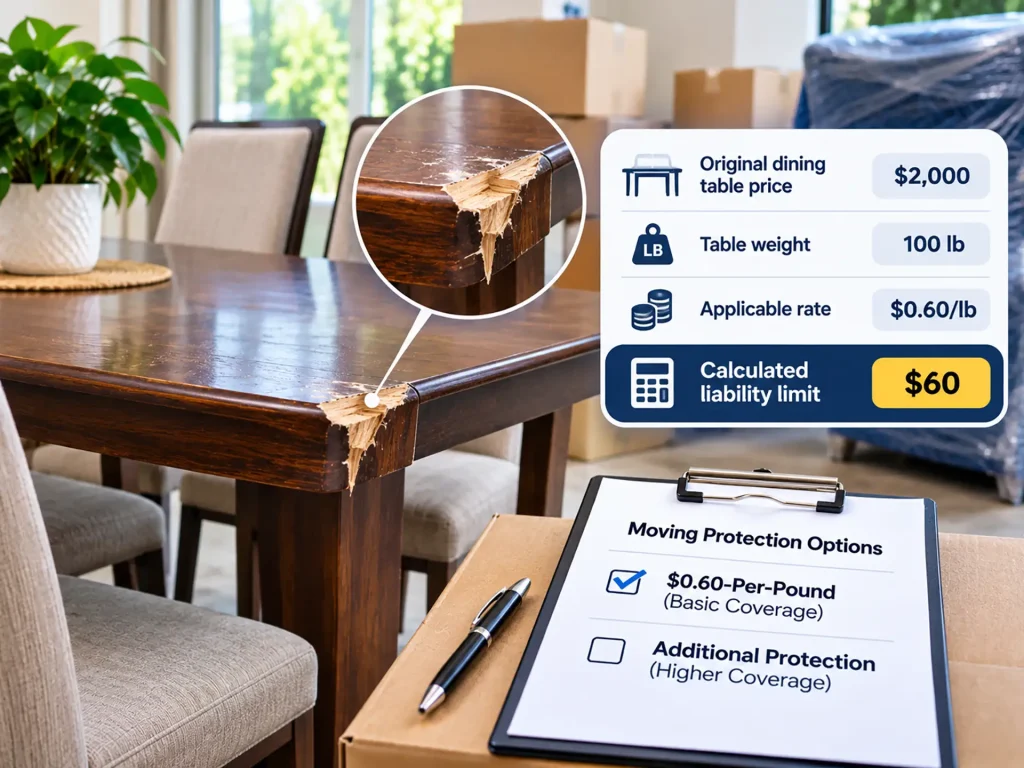
A dining table that originally cost $2,000 doesn’t necessarily qualify for a $2,000 payment.
Compensation depends on the applicable liability terms, the evidence, the type of damage and any additional protection purchased.
How Does $0.60-Per-Pound Protection Work?
Basic released-value liability is generally calculated using an item’s weight rather than its purchase price.
Under basic coverage, certain claims are calculated at $0.60 per pound per article, subject to the agreement and applicable law.
Consider this example:
| Detail | Amount |
|---|---|
| Original Dining Table Price | $2,000 |
| Table Weight | 100 lb |
| Applicable Rate | $0.60/lb |
| Calculated Liability Limit | $60 |
That $60 is an illustrative liability calculation, not an automatic settlement or a determination that the limit applies to every situation.
This difference is why the protection selected before moving day matters.
What If You Purchased Additional Protection?
If the same coverage is available, Replacement Value Protection may offer more coverage for repair or replacement. Deductibles, limits, exclusions and settlement conditions may apply.
The value of a shipment is not necessarily the value that is paid.
Other valuable items, such as antiques, artwork, etc., may be subject to separate declaration or insurance requirements.
To find out more, check out Economical Movers’ moving insurance and moving protection guide.
Can You Request Repairs Instead of Compensation?
Yes. An estimate in writing to restore damaged furniture can help determine its cost.
If you are thinking about arranging the repair yourself, allow the company to inspect the item first. Record the condition of the item and the urgency of the repair if it is necessary to prevent further damage and/or address safety concerns.
Note: Economical Movers’ service agreement reserves the company’s right to choose a contractor for necessary repairs.
6. What Happens After You Submit Your Claim?
The moving company could inspect your photos, inventory, delivery documents and liability documents.
It may request further evidence, schedule an inspection or determine if repairs are warranted.
A broken dining table could need an assessment to determine the necessary repairs, for instance, and the missing numbered box could be checked against the shipment documents.
What If The Moving Company Doesn’t Call Back?
Document when the claim was made and when it was acknowledged.
When no response is received, follow up your original submission by sending a written follow-up. Inquire if the claim has been received, if additional paperwork is required, and when you can expect a response.
Just because you follow up doesn’t mean that you are extending your contractual or legal deadlines!
No one knows the exact time a settlement will take with every Ontario mover.
How To Determine If A Settlement Offer Is Right For You
Be sure to check if the proposed amount or repair includes all the items you are claiming.
Look for a requirement to sign a release. A settlement agreement may affect your right to seek further compensation.
Seek advice before you sign in order to ensure that you know what you are signing, what you are waiving and what you are not.
What If The Moving Company Refuses To Pay For Damages?
- Request the reason for the denial in writing.
- Insufficient evidence, disagreement as to when damage occurred, liability exclusions or the protection selected may lead to a dispute over the claim.
The reason will give you a hint as to what evidence to provide next.
7. What Can You Do If You Have A Denied Claim?
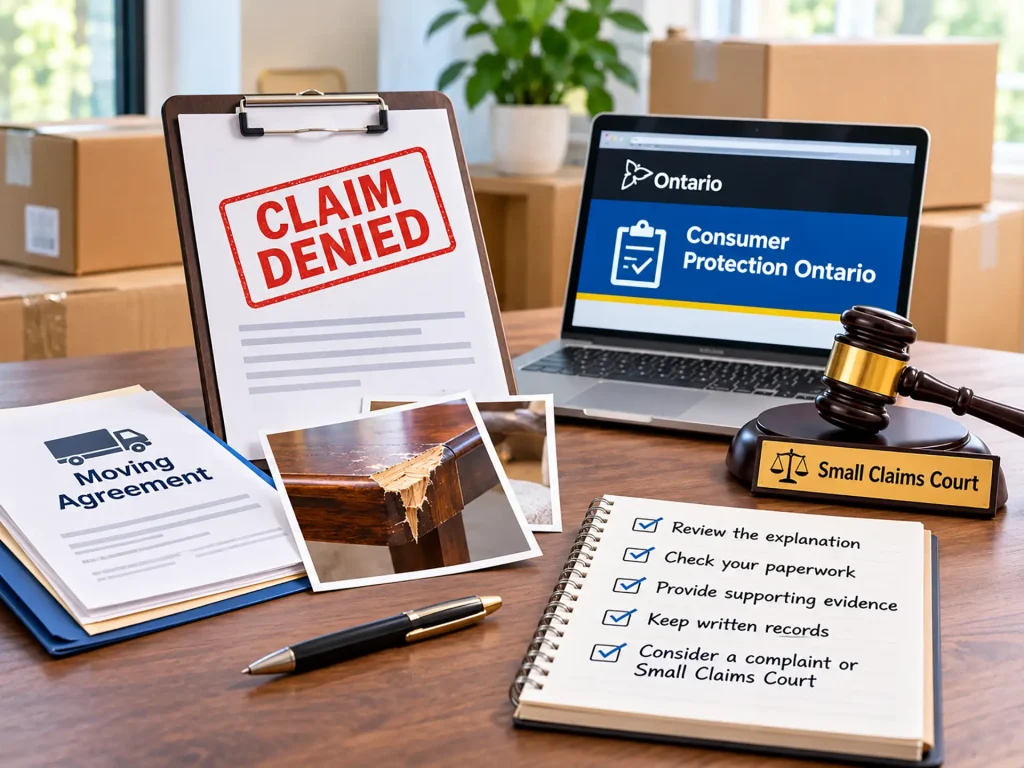
Check the company’s explanation against your moving agreement and paperwork.
For instance, if the company states that the damage wasn’t caused during the move, then provide any previous photos, delivery notes or communications that support your position.
If the dispute involves compensation, ask for an explanation of the liability calculation and which part of the contract is being relied upon.
Stick to the facts and keep everything in writing.
Can You File a Complaint In Ontario?
If you can’t solve the issue with the moving company, you can file a complaint with Consumer Protection Ontario.
A complaint will be reviewed by the ministry, and the ministry may decide to take further action if it deems the matter to fall within its jurisdiction. However, it does not provide compensation or resolve all private contractual disputes.
Is It Possible To File A Small Claims Lawsuit Against A Moving Company?
Small Claims Court is a court for monetary claims of up to $50,000 in value, and this limit took effect on October 1, 2025, in Ontario.
All procedures, documents and fees for the Small Claims Court are detailed in the government’s guide.
Generally, in Ontario, there is a two-year limitation period for commencing many civil claims, beginning from the date of discovery, with exceptions provided in the Limitations Act, 2002.
This is unlike the claim notification provisions in a moving agreement, where the contractual claim period is separate from the court limitation period. A longer time does not mean that the earlier contractual time can be overlooked.
Where there is a doubt about a deadline, exclusion or release clause, legal advice may be useful in resolving the uncertainty about your rights.
8. What Can You Do To Protect Yourself Before Moving Day Is Here?
The Easiest Claims To Investigate Are Those Supported By Clear Records From Before And After The Move.
Before moving day:
- Take photos of expensive furniture that has any scratches, dents or loose parts.
- Create a list of high-value and fragile items.
- Examine the protection and liability stipulations in your written contract.
- Ensure that fragile items are packed by the appropriate person.
- Ask about damage reporting requirements and any special inspections needed.
- Take extra care with items that are very valuable but relatively lightweight.
Refer to How to Transport Fragile Items Safely for further packing advice.
If something breaks, it is too late to find out what the moving company’s damage policy is.
Final Thoughts
If your moving company broke or lost something, make sure to record the issue, report it immediately and adhere to the written claim process outlined in your contract.
Be sure to maintain a record of evidence, understand the principles of liability and ask for explanations when a decision or settlement is not clear.
Documenting The Damage Is Important, But Being Able To Demonstrate It Is Equally Important.
This article gives consumers general information, not legal advice. The result of the claim will be based on the facts and contractual terms, as well as the applicable law.