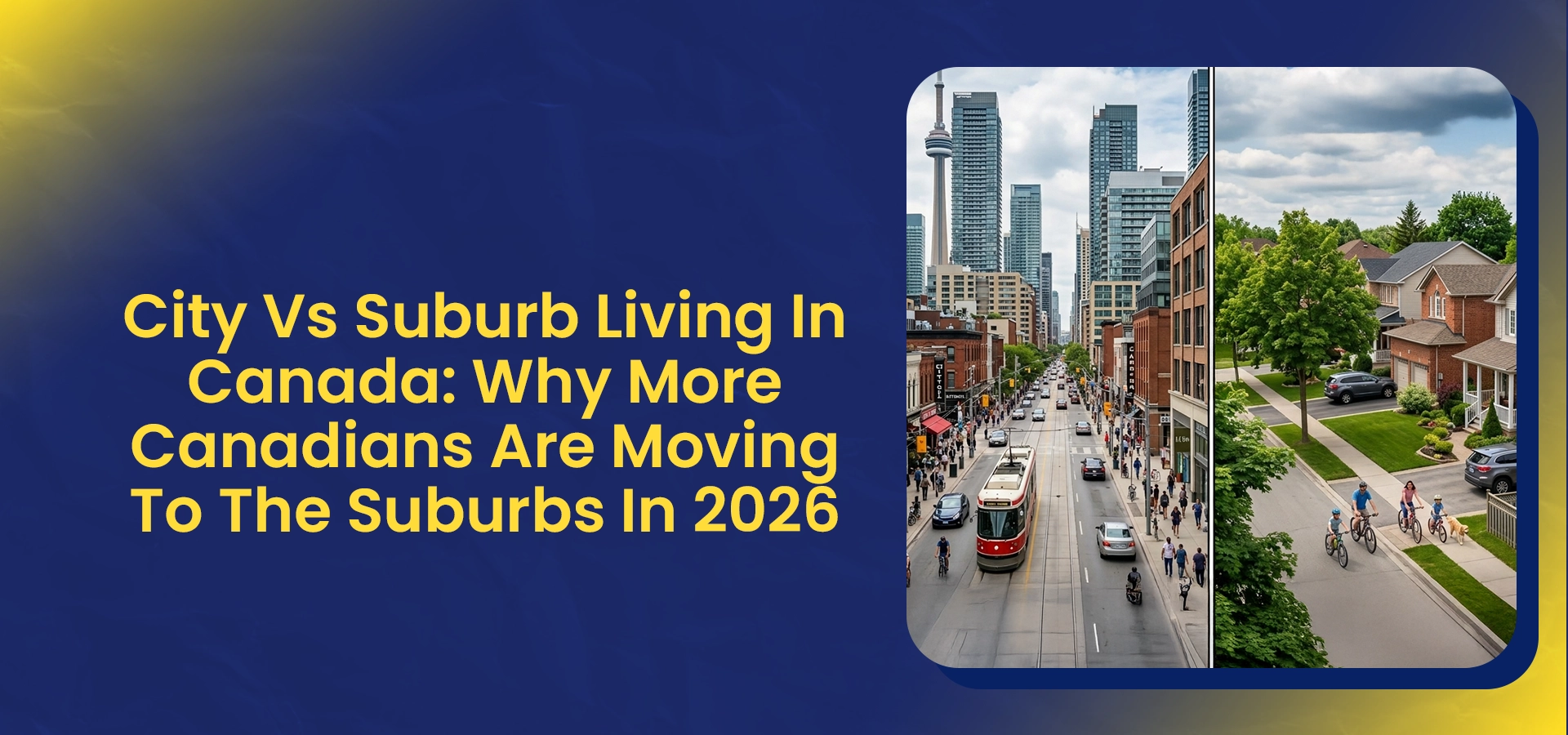
Discover Why Canadians Are Moving To Suburbs In 2026, From Lower Housing Costs To Remote Work Flexibility.
The white-noise hum of the city is fading, replaced by the quiet rustle of backyard maples. As we navigate 2026, the Canadian dream has officially moved to the outskirts. Why Canadians are moving to suburbs isn’t just about escaping traffic; it’s a high-stakes pursuit of sanity and space.
From the booming Ontario suburbs to the lush valleys of the West Coast, the narrative is shifting. Moving from the city to the suburbs was once a compromise; today, it is a power move. Driven by the “Condo Squeeze” and a permanent hybrid work revolution, families are ditching shoebox apartments for actual square footage.
But is the suburban lifestyle in Canada truly the promised land, or just a different set of trade-offs? Before you pack the moving truck, let’s dismantle the myths and map out the reality of moving to the suburbs in 2026.
The Financial Breaking Point In Major Canadian Cities
For years, living in the heart of Toronto or Vancouver was seen as a luxury worth the price tag. But in 2026, that “price” has evolved into a financial breaking point. While the market has stabilized compared to the chaotic peaks of 2022, the carrying costs of urban properties are squeezing even high-earning professionals out of the core.
Rising Housing Costs In Urban Centers
According to the Canada Mortgage and Housing Corporation (CMHC) Housing Market Outlook 2026, housing demand patterns are shifting, with some of the most expensive markets in Ontario and British Columbia experiencing softer sales activity. In the City of Toronto, the average home price in the Greater Toronto Area remains around $1.0 million as of early 2026 (Source: WOWA/TREB). For many, the dream of a detached home in the city has been replaced by a “forever waitlist.”

The Condo Squeeze
It isn’t just the mortgage that hurts; it’s the “hidden” costs of the Condo Squeeze. Maintenance fees in downtown Toronto have climbed significantly, with many buildings now charging between $0.75 and $0.95 per square foot (Source: Homeplicity).
- The Reality: For an 800 sq. ft. condo, monthly maintenance fees can range from $600 to $760 or more, depending on the building.
- The Shift: This “dead money” is a primary reason why condo owners are eyeing freehold townhomes in the suburbs, where that same $760 could contribute toward equity in a larger space.
Urban Rent Vs. Suburban Mortgage Payments
The gap between renting and owning has become a “canyon” in the city. Zoocasa analysis shows that in the Greater Toronto Area, monthly homeownership costs can exceed rent by hundreds or even over a thousand dollars, depending on mortgage rates and home prices (Source: Zoocasa). However, when you move your search to the suburbs, that math changes. Families are realizing that the “rental premium” they pay to live in a cramped downtown apartment could be put toward a mortgage for a suburban home with a backyard and a three-car driveway.
🛑 Market Reality Check
Ontario is the only region expected to see price declines in 2026.
Prices are expected to fall, especially in the most expensive urban centres due to high inventory and muted sales. (Source: CMHC SCHL)
City Vs Suburb Living In Canada: A Quick Comparison
When choosing where to plant your roots, it often comes down to a battle between time and space. In 2026, the gap between these two lifestyles has widened, making your choice more about long-term financial health than just a shorter commute.
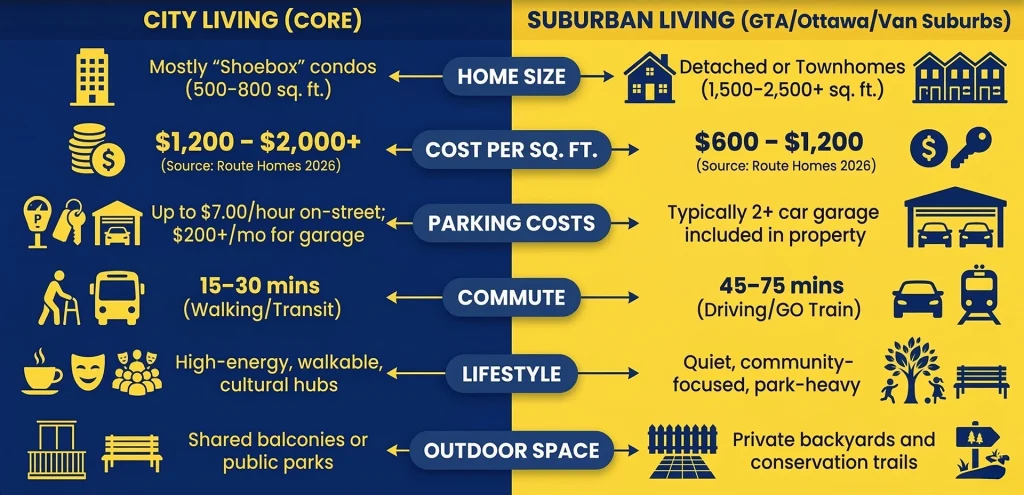
The Side-by-Side Breakdown
The “Hidden” City Tax: Parking and Maintenance
A major factor driving the move to the suburbs in 2026 is the rising cost of simply existing in the city.
- The Parking Hit: In April 2026, the Toronto Parking Authority implemented rate hikes, pushing high-demand on-street parking to $7.00 per hour (Source: CP24/TPA News 2026). Suburban residents, meanwhile, enjoy “free” multi-car driveways.
- The Space Value: You are effectively paying twice as much per square foot for city space. For the price of a 600 sq. ft. condo in downtown Toronto ($720,000+), you could potentially secure a 1,200 sq. ft. modern townhouse in a developing suburb.
Why Suburban Areas Offer Greater Value For Many Families
In 2026, the value proposition of Canadian suburbs has shifted from “affordable alternative” to “superior lifestyle investment.” For families, this transition is driven by three core pillars of value:
1. The Space Advantage
Suburban homes offer a massive square-footage premium. While a $1 million budget in downtown Toronto buys a 650 sq. ft. condo, the same investment in suburbs like Whitby or Milton secures a 2,000+ sq. ft. detached home.
- Practical Gain: This allows for dedicated home offices essential as 40% of Canadians maintain hybrid roles plus finished basements for storage, avoiding the $150/month fees associated with urban self-storage units.
2. Family-Centric Design
Suburbs are engineered for child-rearing. Unlike the “vertical living” of the core, suburban tracks prioritize low-traffic cul-de-sacs and immediate proximity to green space.
- The Stat: Residents in suburban Ontario typically live within 500 metres of a public park or trail system, compared to the 15-minute transit rides often required to reach major urban parks.
3. Integrated Infrastructure
Modern 2026 developments are “15-minute communities.” New hubs in areas like Kanata or Vaughan now feature integrated healthcare clinics and “super-schools,” reducing the need for cross-town travel for basic essentials. Families gain back hours of “lifestyle time” previously lost to urban congestion.
The Hybrid Work Revolution Is Changing Where People Live

The traditional “nine-to-five” grind in a downtown cubicle has been replaced by a flexible, results-oriented model. As of 2026, hybrid work has become the standard for Canadian knowledge workers, fundamentally decoupling where we work from where we live.
- The Commute Trade-Off: Most professionals now only travel to the office two or three days a week. While a suburban commute might take 60 minutes, doing it only twice weekly reduces total travel time by 40% compared to a daily city transit routine.
- The Productivity Bonus: Statistics Canada data reveals that teleworkers save an average of one hour per day by avoiding the commute. Families are reinvesting this “found time” into childcare, exercise, or local community engagement.
- The Home Office Standard: Modern suburban buyers no longer view a home office as a luxury but as a core requirement. With companies like RBC and the Federal Public Service settling into multi-day in-office mandates, a dedicated, quiet workspace is now the most critical feature for maintaining career performance from the outskirts.
Key Factors To Consider Before Moving To The Suburbs
Before trading your condo keys for a suburban driveway, it is essential to look beyond the floor plan. The shift involves a fundamental change in your monthly overhead and daily rhythm.
1. Property Taxes and Utility Costs
A larger detached home requires more energy to heat and cool. While a downtown condo fee covers some utilities, suburban owners handle everything. Expect higher property taxes as municipalities fund new infrastructure; for example, the City of Ottawa website provides a tax estimator to help you budget for these annual increases.
2. Transportation and Daily Commutes
Suburban life often necessitates a vehicle. You must factor in fuel, insurance, and wear-and-tear. While the GO Train or light rail offers a reprieve from traffic, monthly transit passes can exceed $250, a cost often overlooked when calculating “cheaper” suburban living.
3. School Capacity and Community Growth
Fast-growing regions like Milton or Stittsville sometimes struggle to keep pace with an influx of young families. This can lead to temporary “holding schools” or waitlists for local childcare. Always verify the current enrollment status with the local school board before finalizing your purchase.
Should You Move To The Suburbs?
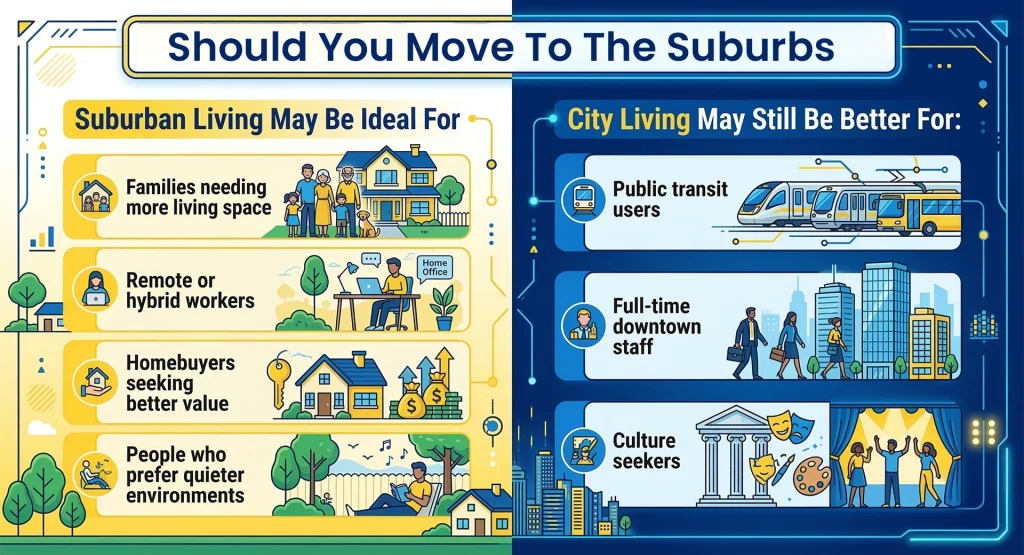
Choosing your next home is a balance between your current needs and your five-year plan. To help you decide, we have broken down who each lifestyle serves best.
Suburban Living May Be Ideal For:
- Families needing more living space: If “the condo squeeze” is real and your kids need a backyard or a playroom, the suburbs offer the square footage you cannot find in the core.
- Remote or hybrid workers: When your home is also your office, a dedicated quiet room is essential for productivity.
- Homebuyers seeking better value: You get significantly more “house per dollar” outside the city.
- People who prefer quieter environments: If you value birdsong over sirens and traffic, the outskirts are calling.
City Living May Still Be Better For:
- Public transit users: If you prefer the TTC or SkyTrain over owning a car, the city remains superior.
- Full-time downtown staff: Commuting five days a week can quickly lead to burnout.
- Culture seekers: If you want a 10-minute walk to theaters, Michelin-star dining, and nightlife, the urban core is unbeatable.
According to recent TREB (Toronto Regional Real Estate Board) data, suburban inventory levels are rising, giving buyers more leverage to negotiate than in previous years (Source: trreb.ca).
Planning A Successful Move From The City To The Suburbs
Transitioning from a high-rise to a house requires more than just a bigger truck. It is a fundamental shift in how you budget your time and money.
1. Evaluate the True Cost of Commuting
Beyond the distance, you must calculate the “hidden” commute tax. Using the CAA (Canadian Automobile Association) Driving Costs Calculator, you can see that fuel, maintenance, and insurance for a suburban commuter often exceed $8,000 annually. If your route includes the 407 ETR or other tolls, these daily fees can quickly erode the savings you gained from a lower mortgage.
2. Research Future Neighbourhood Development
A quiet street today might be a construction zone tomorrow. Always visit your local municipal website to review Official Plans and Zoning By-laws. This reveals whether the nearby forest is slated for a new shopping plaza or if a high-density transit hub is coming to your backyard. Understanding the 10-year vision for your street prevents “buyer’s remorse” after the move.
3. Prepare for a Different Type of Move
Scaling up from a 600 sq. ft. condo to a 2,000 sq. ft. home is logistically demanding. You aren’t just moving boxes; you are suddenly responsible for lawnmowers, snow blowers, and furnishing multiple empty rooms. Professionals recommend auditing your belongings early to see what urban furniture, like “apartment-sized” sofas, might actually look out of place in a sprawling suburban living room.
Why Ottawa’s Suburbs Are Attracting New Homebuyers
Ottawa has become a magnet for families seeking a “Goldilocks” balance: urban stability with suburban space. Unlike the volatile GTA, the National Capital Region offers reliable employment anchored by the federal government and a thriving tech sector.
Growing Suburban Communities Several key hubs are leading the charge:
- Kanata & Stittsville: The high-tech heartland with premium amenities.
- Barrhaven & Riverside South: Rapidly expanding zones perfect for young families.
- Orleans: The premier choice for those seeking French-language services and established transit.
Balancing Space, Employment, and Lifestyle According to Royal LePage, Ottawa remains one of Canada’s most “attainable” major markets (Source: royallepage.ca). By moving to these outskirts, buyers secure detached homes for the price of a downtown Toronto condo, all while staying within a 30-minute drive of the historic city center.
How Movers Help Make A Suburban Move Easier

Relocating from a compact high-rise to a sprawling suburban home presents unique logistical hurdles. Navigating tight elevator bookings and downtown loading zones requires the precision only experts can provide. This is where Economical Movers excels, specializing in helping families transition to larger spaces.
Our team expertly handles oversized furniture, sensitive home office equipment, and bulky garage items that often don’t fit in standard DIY vans. By coordinating your packing and long-distance transportation, Economical Movers ensures your arrival is as seamless as your departure. Choosing a team familiar with suburban routes, such as the expanding crescents in Kanata or Whitby, means avoiding delays and ensuring your belongings are placed exactly where they belong in your new, spacious future.
Final Words For Choosing The Lifestyle That Fits Your Future
As we navigate the evolving landscape of 2026, the shift toward suburban living in Canada represents more than just a change of address; it is a recalibration of what “home” truly means. The data clearly shows that while the urban core still offers unmatched cultural energy, the suburbs have matured into self-sustaining ecosystems. For families, the trade-off of a longer commute is often outweighed by the tangible benefits of a private backyard, dedicated home offices, and a lower cost per square foot.
Choosing between the city and the outskirts ultimately depends on your personal stage of life and career flexibility. Whether you are drawn to the tech hubs of Kanata or the quiet streets of the GTA, success lies in careful financial planning and choosing the right partners, like Economical Movers, to bridge the gap between your old lifestyle and your new horizons. By prioritizing space and community stability today, you are not just buying a house—you are investing in a future that offers room to grow.
Frequently Asked Questions For Moving To Suburbs
Q. What Is Canada ‘s Urban Population Percentage In 2026?
A. The Canada urban population percentage is approximately 83%, as moving from city to suburbs remains a significant trend for those seeking a balanced suburban lifestyle in Canada.
Q. Which Are The Top 10 Cities In Ontario To Live?
A. Top picks include Ottawa, Toronto, Waterloo, Oakville, and Kingston. Many choose Ontario suburbs within these regions to enjoy a move to suburbs in Canada for families.
Q. When Is The Best Time To Move To the Suburbs?
A. Deciding when moving to suburbs is right depends on space needs. Why Canadians are moving to suburbs often involves seeking more room and better local schools.
Q. How Do I Move To The Suburbs Near Ottawa?
A. To move to suburbs in Canada near Ottawa, consider Kanata or Orleans. These Ontario suburbs offer affordability, making the transition when moving from city to suburbs seamless.